Showing posts with label CentralAsia. Show all posts

Saturday, October 23, 2010

Apologies for the break – I was busy finishing a piece of writing and didn’t have any spare time to continue the Pamir roadtrip story.

Where were we? We were still on Day 2, having just arrived into Khorog, and were exploring the gardens at the Serena, while Dan napped off his stomach bug. We can cover the remainder of that day plus Day 3 (In Khorog) here.

By about 5 in evening Dan forced himself out of bed to show us a bit of the town, and we went to have a bite to eat and a pleasant time relaxing on the tapchans at the Chorbogh teahouse (operated by the group of Aga Khan organizations, just like the Serena – the AK development network seems to kind of run the Pamirs, or at least Khorog). The teahouse is situated just on the banks of the river Gunt, in a corner of the Khorog city park, with a raised platform hanging out over the river and the icy blue-green water rushing by below.

The town itself feels quaint and small, although it also has the bustling feel of a regional hub, and the center of town right next to the bazaar housed a constant crowd of travelers and touts and small-time sellers and minibuses and SUVs – the marketplace for anyone wanting to depart the Pamir region for west-central Tajikistan and not aiming to pay for one of the very limited airplane seats out of town (meaning almost any ordinary traveler).


Khorog is a border post, founded in the 1890s by the Russian military as the boundaries between British-controlled Afghanistan and Russian-controlled Central Asia were firmed up, so in a sense, although the town is picturesque, it isn’t surprising that it also has a hint of the rough and ready menace of a border station. And maybe because our visit coincided with a holiday weekend, including Tajikistan’s independence day, for which there was a large public celebration in the city park, there was also at times an ever so slightly trashy feel – drunks hanging around on the edges of the park, groups of men ranging around after the late afternoon breakup of the local football match, and literally lots of remaining litter lying around in the park after the main heaps of trash had been carted away on the actual holiday. So Khorog was a pleasant break during our travels but certainly not home to us, as tourists and visitors.

We had a peaceful stay at the Serena, got rested up, and refroze the ice packs from our cooler. Continued to meet up with random travelers you’d never imagine would bother to make their way to Tajikistan, although I suppose that for them that’s the point: the Pamirs in a real sense are the end of the world, following in Marco Polo's footsteps, that kind of thing. On our first evening we’d already met up with a group of San Diego based travelers in Kalai Khumb who were making their way from Osh in Kyrgyzstan (I was surprised, given the relatively recent violence there) to Dushanbe, by way of Khorog. They claimed they’d visited (or would soon have visited?) every country in the world. “There’s a group of us,” their ringleader noted, by way of explanation. Who knew? In Khorog we crossed paths at the Serena with a French family traveling in a 2-car caravan. They had driven overland all the way from Europe and aimed after an exploration of the Pamirs to end up in Tashkent, where their university-aged son had a reservation to fly out in a few weeks’ time.

We also spent a thoroughly enjoyable morning in the Khorog Botanical Garden, perched up on a hill above the Shakhdarya river, on the southeast edge of the narrow town. (Khorog is situated in a narrow gorge, where the Gunt runs westward and intersects with the northward flowing – at this stage – Oxus. It basically has room for one main east-west street on the north side of the Gunt and a few secondary ones parallel to it.) Not much more to report on here except a slow meander through the semi-wild gardens and admiring (and taking snapshots of) the flowers, groves, and the imposing and tacky new mansion the president of Tajikistan has built for himself at the edge of the grounds. (The Serena, where he used to stay, apparently is no longer good enough. But thinking about that made us realize, kind of ickily: ‘wait, if we splurged to stay in the deluxe suite at the Serena, probably we’re sleeping in the same bed where Rahmon has slept!?’)

The brief R&R was good for our peace of mind, and Dan began to feel better. After a phone consultation with our Dushanbe medical provider, he decided to get his hands on some metronidazole, on the suspicion that he’d gotten giardia. We had a moment’s doubt about whether we could find it in Khorog, but then we realized that the prevalence of stomach bugs in this part of the world meant that actually this was probably the easiest medicine to get your hands on in a local drugstore. And we were right. He started to improve after 1 or 2 doses of the meds.

On the negative side, Monday morning we got a phone call from Dushanbe, alerting us that, in addition to the recent 25-man jailbreak and reported suicide-bombing at government buildings in Khujand, there were now reports of a bomb (or a fight? in Tajikistan rumor is king) in a local Dushanbe nightclub on Saturday night. That was slightly unsettling news, although the rational mind would tell you that in the remote eastern Pamirs you’re about as safe from unrest and political violence as you can be in Tajikistan.

Another negative that was nagging at both Dan’s and my mind, as we prepared to set out on our eastern loop through some of the most remote and unprovisioned territory in the country, stemmed from the unfortunate fact that the X-Terra’s “Service Engine Soon” light had lit up just as we pulled into Khorog, and it hadn’t yet gone off. Although the message was ominously vague, after consulting the owner’s manual, we’d established with pretty good confidence that in fact it was primarily a warning about the emissions system. Bad gas from a brief refueling stop in Kulob, perhaps? We weren’t sure, but we convinced ourselves that it probably didn’t mean we were in danger of breaking down. We hoped.

After our second morning enjoying a hearty breakfast in the Serena dining room, overlooking the sunny garden and riverbank, we gassed up again at the much more trustworthy-looking main gas station in Khorog (hoping the possibly bad Kulob fuel might get diluted?), and set out southward on the road toward Ishkashim.

Friday, September 24, 2010

Bumping to Kalai Khumb, Limping into Khorog

Well, I took a short break in real time to visit Norway, and let me tell you: visiting one of the most remote parts of the world (the Pamirs), followed by one of the most progressive parts of the world (you guess), followed by your return to the sort of semi-deprived point on the map that you now call home can give you situational and psychological whiplash. It is good to be home, but also sad to leave behind those little comforts (and friends), your fondness for which (and whom) was brought back to you in vivid color during your weekend away.

But back to our trip to the mountains, still occurring in narrative time:

Day 1 into Day 2 (Kalai-Khumb to Khorog. 240 km, ca. 9:00 am - ca. 4:00 pm, approx. 7 hours)

Midday into our first leg of the journey, we passed through Kulob and picnicked on the other side, still feeling excited for the road ahead.* At that point, another kind of bad road began: we left the slippery, fine sable-hued dust of the construction zones in the Khatlon hills and headed for the red dried mud, steeper inclines, slightly more hair-raising switchbacks, and, I can say in retrospect, medium-grade bumpy road that led between about Shurobod and Zigar. We also crossed successfully (that outcome was actually more in doubt than anyone expected setting out on our journey) the requisite iffy bridge that I think any journey in Tajikistan worth its salt must include.


Once we crossed into Darvoz proper at Zigar (recall the map), the road again included surprisingly well-paved patches. Here the Iranians, Turks, and Chinese are dividing up the road and improving it, although apparently on their own individual schedules and with their own idiosyncratic materials, methods, and plans.

We pulled into Kalai Khumb nearing dinner time and fairly quickly located our guesthouse. Since I was the passenger, it fell to me to go in and determine whether our attempt to make a reservation had really worked. It became clearer later on that it actually hadn’t, but we still got a room. The main problem when we first arrived was that my head, my neck, my shoulders – really, my whole body just felt like it had undergone some kind of human jackhammer experiment gone awry, and I was tired to boot. The synapses in my brain seemed literally to have been jostled and split, so I kind of had trouble expressing myself to the guy and explaining that we needed a room for 3 people but that it ought to be somewhere on his “reservation list.” Part of the problem was I really wasn't sure at first what language to speak, Russian or Tajik, so a bad mixture with words forgotten in each came stuttering out of my mouth. In any case, we quickly sorted it out and were shown to a double on the first floor of the small guesthouse building.

We had been unsure in any case whether we even wanted to stay in this place, since the advance report last year had steered Dan away due to bedbugs. (Dan and colleagues spent the night at the recommended Kalai Khumb alternative, only for Dan to wake up scratching his entire inflamed midsection due to – you guessed it – bedbugs. But because of that experience, we figured, we might as well try the original place.)

The guesthouse was actually very enjoyable in a Spartan kind of way, a pleasant surprise. OK, it didn’t quite merit the term “bed and breakfast,” which for Westerners is too loaded with charm and quaintness to do justice to hardly any lodging experience in Tajikistan, but the rooms were fine, the mattresses and bed linens clean, and the walls had no signs of bug squishage, which we’d been told was one way to detect a bedbug infestation. Dinner was a welcome and hearty portion of both pasta and rice with a saucy chicken and tomato kind of thing to pour over it. Large pot of green tea, a platter of dried nuts and raisins: the whole 9 yards (well, maybe 7, but in provincial Tajikistan that's a long way!). Our host even offered Dan a cold beer to start out, although it was the less savory Baltika #9 instead of a 7 or even a 3. But hardly a discomfort. We were quite happy to have a peaceful meal on the balcony overlooking the small, rough garden, and to watch the basin of the mountains rising out in front of us as they darkened into dusk.

Night unfortunately brought little sleep – Anya was hopped up, and it was hot and stuffy in the room. But we still anticipated that we’d get moving in the morning and everything would get back on track.

That was until the wee hours of morning, when at least for Dan himself that hope started to go south as he got extremely nauseous. I found out only as we rose and got ready for breakfast (which he was unable to eat) that his stomach was presenting some serious problems.

So we started out on the road to Khorog with a bit of trepidation. A few sickness stops into the ride that feeling really had not abated, although this leg of the journey was at least not terribly long. I drove a portion of the way, when Dan felt so terrible he didn’t want to drive anymore (he insisted it was at least a distraction from the stomach pain until it got very acute). But as we neared the last few kilometers before the hotel, on the outskirts of Khorog, with Dan back in the driver’s seat, we heard a wail from the backseat and turned to see projectile vomiting inside the car from passenger #2! Trepidation took a turn toward dread with that one.

It was actually just motion sickness with Anya, instead of anything she ate, but we really only determined that later on. And even that fact didn’t exactly lessen our feeling of foreboding, since for Dan car sickness is actually a pretty serious and consistent problem. The notion that the kid might be barfing all the way through days two through eight of our journey didn’t lighten our mood.

We stopped for a short clean up along the side of the road, with the requisite wide-eyed Tajik kid staring at us the entire time, and headed the final half hour or so to the 4-star Serena Inn. (Dan very wisely planned our itinerary with variation, between splurging on the very comfortable Serena and staying at places more lacking in the mod cons before and after.)

Once checked in, we had a quick but serious bath for everyone, sick and healthy. Dan headed for bed, and Anya had a quick snack (very enthusiastically eating the very same thing she’d upchucked all over the car – homemade granola – lending more evidence that she was not seriously ill, thankfully). Then Anya and I went out to explore the Serena’s very extensive and quite beautiful terraced riverside garden, while Dan slept through his fever.


Next report: our fearless leader rallies from the sickbed to show us the fine city of Khorog on our first evening in town.

----------
* Side note on the security happenings that forced us to travel the southern route: a very good overview of what is happening in Tajikistan following the jailbreak and other events, and their larger significance, can be found at Stratfor.

Wednesday, September 15, 2010

Day 1: Dushanbe to Kalai Khumb

368 km, actual road time: 9:30am-ca. 6:00pm; approx. 8.5 hours.

Started out later than intended (of course), and had to get some additional provisions before we left town (needed to gas up and buy the inevitable bag full of lepyoshka/Tajik flatbread, which isn’t worth getting very far ahead of time because it quickly goes stale). Also reluctantly swung around the house again for a quick grab when we realized we hadn’t packed any booze.

The theme for days 1.5 of the journey was frankly how bad the road was. The quality of the road and our relationship to it was a theme on which we had chance to meditate throughout. But on the early legs of the journey, spent basically getting to remote Badakhshan (where I guess I assumed the roads would be worst), Dan and I were both surprised at how inferior the road was, especially the lead up to Kulob and the stretch from Kulob to where the road nears the Panj River. Our main complaint as we rose and fell through the high hills (or low mountains, depending on your perspective) that progressively grow as you go south from Dushanbe concerned the long dusty stretches where apparently some kind of road work was ongoing, although not exactly always actively in process. (To be fair, it was still Ramadan at that point, and I do think there was more activity actually happening on this stretch when we drove home the day following Eid.)

If you want to see this on a map, I'm plotting out points on the way here on Google Maps.

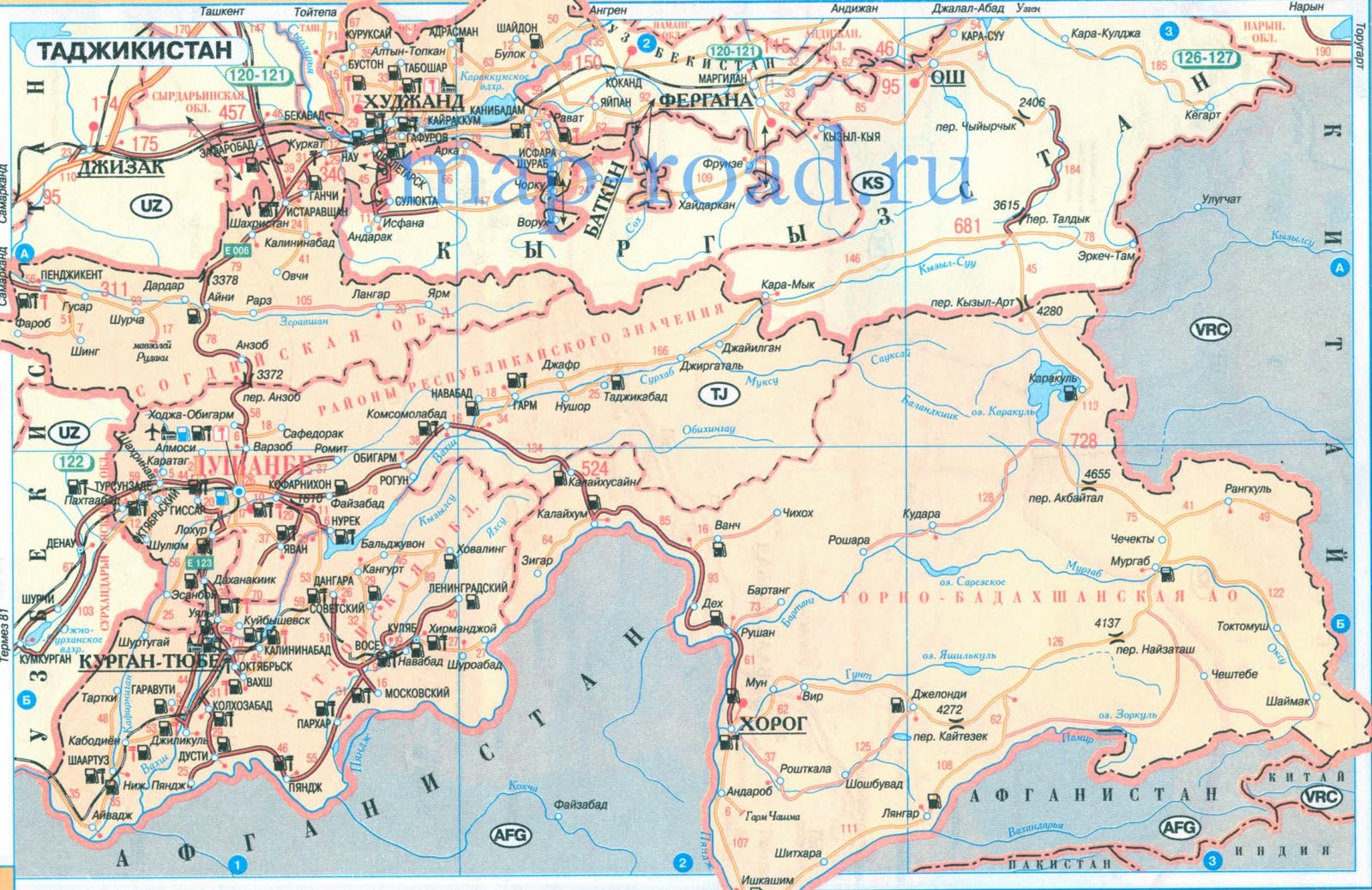
Also, if the Cyrillic is not a deterrent, here is a map below (click on it to get a larger view), which, now that I look at it, might have given me a more realistic expectation of the roads had I looked at it before we went -- notice the very absent road line, for instance, between Khirmanjoi and Zigar. And the yellow portion between Nurak and Danghara. It actually is a very accurate representation of the roughly 3 types of road conditions we met (terrible, bad, and acceptable/good). Brings that aspect of our trip belatedly into very sharp focus for me!


Here are a couple of shots of the scene out the window (this gives you no sense of the feel of the ride, however -- on the way home I actually started taking short video clips to at least record for my own memory just how much we were being shaken, though mainly in the middle portion in Darvoz, not here in Khatlon province). You can see more on Flickr.


Next stop: Kalai Khumb for a night's rest.

Monday, September 13, 2010

8 Days To the “Roof of the World”


I’m afraid my impressions of the trip we took over the recent short week (Labor Day for those who get US holidays, and 2 days off for Tajikistan’s Independence Day and Eid) are already fading, and I’m desperate to write them down and save them. At the same time I’m having that familiar feeling of anticipatory disappointment at the way that words and even the photos you’ve taken can only poorly convey an experience, even for your own memory.

This was a trip we, especially Dan, had been planning for months, a weeklong road trip to the remote Pamir mountains and plateau, Tajikistan’s “Autonomous Region of Mountainous Badakhshan” (abbreviated in Russian as GBAO). He went last year at about the same time for work, so he had a better idea of what we were in for, in all senses of the phrase, while my notion of the trip was more vague.

I knew our itinerary as we planned it – from pictures and the telling I had some ideas of what it meant, but largely it was just place names:

Saturday, Day 1. Dushanbe to Kalai-Khumb (368 km, approx. 8 hours)
Sunday, Day 2. Kalai-Khumb to Khorog (240 km, approx. 5½ hours)
Monday, Day 3. In Khorog.
Tuesday, Day 4. Wakhan: Khorog to Langar (215 km, approx 6 hours)
Wednesday, Day 5. Langar to Lake Yashilkul (~120 km, approx. 4 hours)
Thursday, Day 6. Lake Yashilkul to Khorog (~195 km, approx. 3.5 hours)
Friday, Day 7. Khorog to Kalai-Khumb (240 km, approx. 5½ hours)
Saturday, Day 8. Kalai-Khumb to Dushanbe (368 km, approx. 8 hours)

On the first leg we would take one of two possible routes to get from Dushanbe to the eastern region of Tajikistan: either the northern route, through the lower mountains and valleys due east of Dushanbe, traveling part of the route we took in March to see buzkashi in Gharm, via the Rasht valley, but shifting south and going through Tavildara; or the southern route through the agricultural expanses of Khatlon, the southern towns of Danghara and Kulob, rounding upward toward Badakhshan. For our sake and Anya’s, we’d break up the trip that most travelers make in a Herculean single drive of anywhere from 14 to 24 hours and more, depending on road conditions. From the middle ground of Darvoz (literally, “gateway,” in Persian) we’d climb to the chief city of GBAO, Khorog, and after a day’s rest and sightseeing there, we’d follow the looping Panj River (more familiar generally as the Oxus or Amu Darya) ending up moving east through the Wakhan Valley, a remote finger of lowland shared warily by Tajikistan and Afghanistan, with the Hindu Kush peeking out from the south. Then we’d skirt northward to the lower sections of the Murghab plateau, and, meeting the main Pamir Highway, we’d return westward, back to Khorog, and from there retrace our tracks homeward via Darvoz.

The earlier debate about the “two possible routes” quickly ended after the recent Dushanbe jailbreak. The prisoners supposedly had fled to Rasht, traditionally a base for the political opposition in all its incarnations, and security recommendations from the American Embassy pointed us firmly southward. It’s hard to explain, but the escape didn’t worry us very directly on personal safety grounds. It was mainly a confusing event – ultimately followed by several others this week, but as an isolated event it called into some slight question general political security here rather than promising hardened criminals around every bend. We didn’t feel any need to call off our trip, but we did follow the guidelines and avoid what was possibly the hottest spot in what was a slightly warmed over general security situation.

I’ll try to set down my impressions of the progressive stages of the trip here over the next few days. As the vagaries of planning would have it, this Friday we’re already setting off again on a long weekend trip from Dushanbe to Oslo that defies credibility. So my fears about preserving the impressions of the journey to the Pamirs are quite real.

For me it was an adventure, a getaway, an exposure to some of the most dramatic and inspiring landscapes I have ever seen. It was a weird inside-out, through-the-looking-glass kind of experience, a trip both outward and inward: staying within Tajikistan, yet going to the edge of its borders, to a region that is extremely different and otherworldly in many respects. Going further inside and in a way digging a level deeper into the isolation and remoteness of our existence here, and yet traveling out into vast expanses, getting away from our physical and psychological lives at home in Dushanbe, away from the everyday. Depression makes you burrow in, in ways that you don’t even recognize, and it’s a gift to be able to escape, even if the return is difficult and the changes you’re able to envision during that reprieve and pledge to yourself that you’ll make threaten to slip through your fingers like the light dust blowing all along the road. You hope that, like that dust in another way, they’ll settle in quietly and barely noticed through every crack and crevice, and all but become a part of you.

Monday, June 21, 2010

Summer Camping Trip

Photos from our goodbye camping trip with 2 families that will leave us soon -- one for a few months and the other permanently -- are here.

Wednesday, May 19, 2010

Around (Part of the) World in the Past 80 Days

A non-chronological rundown from A to Z of what I’ve neglected to report since I last wrote:

A – Archives, in both Russia and Tajikistan. I have been surprised in the last six weeks to learn just how much bureaucracy and apparently arbitrary and informal adjustments to bureaucratic rules really do differ between TJ and RU. I’m sorry I have to be reminded, but I do often forget that it is wrong to lump these two together into a single category. If you want to be wowed, I suggest you work for several months just trying to get registered and allowed to see documents in the sad national archive of a regressing Central Asian nation, and then go overnight to the beautiful oasis of the main reading room at GARF (State Archive of the Russian Federation), with its computerized index system and terminals at each reader station. But be careful not to faint from shock.


B – Buzkashi. The art of dragging around a goat carcass and fighting over it from your position atop a galloping horse. See photo essay.


C – Cheeses. Twelve of them, packed in multiple plastic bags, ziplocs, and stuffed together with a gift freezer pack in Paris into suitcase #3, only to emerge upon arrival in Tajikistan still cool and smelling wonderful. Now awaiting experimental freezing.


D – Disease. Luckily for Anya, only “angina” which, I guess contrary to our use of the word in English (from the Latin for choking or congestion) in reference to chest constriction and heart disease, in French refers to something like tonsillitis or strep throat. It was the sickest she’s actually been her whole life, but she was still a trooper. And our visit to the French pediatrician in Tonnere, France, renewed our already high respect for socialized medicine – bring on that Obamacare, thank you very much!


E – Embroidery. To my great disappointment, I must admit, the needlework has stalled out! But for a good reason: renewed research inspiration and necessity (much-procrastinated research trip to Moscow) made me turn away from the embroidery kind of right at the point where I was going the strongest on it, unfortunately. But I am really glad to feel the new boost in creativity and production, and the work is fun. Whether to keep up with the crafts in this current phase of Dushanbe life is my next decision…


F – France. Mmmmm, 2 weeks binging in the heartland of duck confit, terrine and paté, fromages hard and soft (especially soft and runny Epoisses and Chablis, my favorite of our discoveries), red wine (Burgundy, to be exact), and escargots (Anya to Dan: “dai mne eshche ulitku! [give me another snail!]”). Throw a few raw oysters – and whelks and winkles – on top and you pretty much have our vacation in a nut (or snail) shell.


G – Grandparents. Had a great time with 2 of them in the French countryside – Anya for 2 days longer than we did, and apparently all 3 of them had a blast.


H – Hotels, good and bad. FYI, in Autun, it's probably wise to splurge on the Hotel les Ursulines up in the old town, with the beautiful enclosed garden, despite the nondescript rooms. The incompetent front desk manager at the Hotel St. Louis et de la Poste downtown (together with the single, yet surely not solitary, cockroach we spied) made that one a bust. And the experience kind of ruined the whole next 24 hours, to be honest.


I – Insects. Fleas to be precise, which are the most bothersome ones that have visited us (and apparently left, during our vacation) over the last few months. But with the onset of spring the aphids on the fruit trees in our yard have also come out of hibernation. We are trying to spray with soap and water, but is it possible that Central Asian aphids are immune to this approach?


J – Jeans. In addition to the fact that the fashion right now is very clearly to tuck these into your tall, but flat-heeled, boots, I gleaned many other fashion tid-bits during my many hours walking from archive to archive, and people watching, in Moscow.


K – Kyrgyzstan. In truth, this doesn’t really deserve to be on this list, since ironically (and probably luckily) we could hardly feel further from the unrest and changes there. That is not to say that it might not spill over – you definitely never know. But so far it really seems not to have one iota of an influence here in Tajikistan, and in a practical way for us that is a good thing. In the larger picture I am not so sure that it is in the best interests of Tajikistan’s citizenry to be so complacent, but I am not complaining right now. The “revolution” – or maybe “coup” – occurred while I was in Moscow, and actually I probably knew more about it learning about it from that location than from home in Dushanbe, since while I was there I had the time and the inclination to watch the news quite diligently (and even discuss all of the very interesting, mainly tragic or disturbing, current events, from Kyrgyzstan to Katyn to the Moscow metro, with my landlady). It kind of felt like I was at the center of a much more connected universe while I was in Moscow, while here in Dushanbe everything typically seems very insular, very isolated from what is happening in the outside world. In any case, I include this mention here mainly since so many people have asked us about events in the neighboring ‘stan.


L – Lady drivers. It seems I’m one of them again. More precisely, for some reason when spring arrives in Tajikistan, not only do the local men do a typical double-take for women walking and perhaps wearing something pretty (a revealing mid-calf kurta, or what have you), apparently they also have a habit of looking twice and even staring when they see a woman behind the wheel. Come to think of it, women and kids will crane their necks to check it out, too. It’s just that shocking a sight to see.


M – Moscow! What a big, bewildering city it really is – I had a great time, and although after two and a half weeks there I was ready to get back to the slow pace of life in Dushanbe (and my peeps), the hustle and bustle was pretty fun to experience. It was my first time really living in the city (and right downtown, in a great location, steps away from Kievskaya metro station) and exploring it myself – the town I know best is Petersburg, and Nizhnii Novgorod I suppose is a close second. (Sorry, Vladivostok, I guess you take bronze.) I think I might not even mind spending some extended time in Moscow in the future (although maybe I’d get sticker shock if we really were to live there for a stint, not just visit short term).


N – Navruz. After a week of sun and warmth leading up to the biggest Central Asian holiday of the year, with people getting positively punch-drunk on the weather, it was a big dud. Rainy and cold. Certainly not inspiring for anyone to wear their new kurta, especially if it is still far from being completed…


O – Other scholars/academics. This spring has brought a lot more contact with researchers here in this part of the world, surprisingly many of them here in Dushanbe. It started with the German grad student, studying Soviet history, whom I met by sheer luck near the end of her 5 year stint here in Dushanbe. (5 years because she is also a spouse and mother raising her small kids here; she wasn’t spending the entire time doing full-time dissertation work.) Then it gathered steam with the grad students I met in Moscow, and now, partly because it is summer (those US based academics are smart: avoid Tajikistan in the winter. What a good idea!), there are 3 grad students here in town whom I know. I also met an inspiring independent scholar from Canada and I hope soon to formally meet the German scholar who was working at the desk next to me at the archives today. It’s gotten to the point that I am seriously planning to have an academic dinner party soon, before some of these folks cycle out of here and the population dwindles again.


P – Potty Progress. Hooray! Big girl undies (thin, no soaker panel) + possibly an unusual time-out from preschool teachers in response to her last real accident = I guess a month or more of dryness and a nearly perfect (I’d say ‘spotless’ but that wasn’t actually our problem…) record with trips to the toilet.


Q – “Quiet time.” This was how I explained to Anya what the side chapels in the several French cathedrals we visited were for. She started wanting to go in them with me to catch some together.


R – Rain. Unfortunately we departed from rainy spring weather in Tajikistan (where it is at least warm) only to be met by rain and half-century record low temperatures hovering at or under 10C in France. And now we've returned to TJ, where the rains are just an annoyance in Dushanbe but have left over a thousand people homeless and camped out in the stadium in the southern city of Kulob. Anya and I tried to make a small contribution to help Monday when we brought 4 bags of things of hers and mine that are either no longer worn or have been outgrown to donate for local efforts to assist in Tajikistan’s south.


S – Spring! and the arrival of the “Season”: the season for produce in Tajikistan, that is. When even the neighborhood bazaar has strawberries (sad and soggy though they may be) for sale, you know the highwater mark of fruit and veg season is just around the corner. Sure, you’re still advised to make the trip to Green Bazaar for really good quality and selection, but the season has arrived, for sho’.


T – Train travel. And the miracle of catching our Frankfurt-Paris train, for which we had planned a layover of 3 hours. Ultimately we had to run for it in the 45-minute interval that Somon Air's delayed arrival afforded us. (Anya to Lisa the night before the return trip, in Paris: “Will we have to run for the train again? I didn’t like that.”)


U – Umbrella. Anya was pleased as punch to be given a Winnie-the-Pooh children’s (hey, they probably make them in adult sizes, so I might need to specify) umbrella, after a shopping spree in the hypermarché outside Autun. (Shopping therapy after our bad experience at the hotel? It’s possible.) It made the trip home just fine packed in a suitcase and still hasn’t broken. Surely better quality construction than the 9-somoni jobbie I bought her at the bazaar in Khujand in the winter.


V – Vaccines. The polio outbreak in Tajikistan has given me reason to renew my earlier interest in polio vaccines, both injected/inactivated and oral/live, albeit from a very different perspective. Anya got her first round of the OPV booster series today. The situation is truly serious, but for kids who have received good quality vaccines so far and are up to date like Anya there should not be an extreme risk. With that firmly in mind, I actually think it might do us a lot of good if more academics had to deal with their topics of heated abstract discussion in direct and concrete relationship to their own or their kids' lives. But I guess that probably isn't a widely applicable or appropriate thing to wish for. The experiences is actually very enlightening and provides fascinating insight.


W – Water, dirty. Spring rains (well, any rains, really) bring “brown baths,” as Anya has called them since her first ever dip in the tub here in Dushanbe, a year and a half ago. The water from the tap used to be brown all the time, but shortly after we moved in the city did some improvements (yes, it happens), and the quality on a typical day improved. But we are reminded right now of how extremely cloudy and dingy that water can get. At least it serves as a good reminder that it wouldn’t be wise to drink out of the tap!


X – Хозяйка. Or khoziaika. That is, “landlady.” I had a really good one in Moscow for the 2 weeks I rented a room in her apartment – it was a surprisingly nice arrangement for me, working for many hours during the day and into the evening at the archives, and coming home to have a bit of dinner or tea in the kitchen with Inna Zinovievna.


Y – Yoga! So glad that Dushanbe has seen a renaissance (or I guess simply naissance?) of it in the last 6 months. I am happy to say I’m back to 2 times practicing per week (when not on vacation – but I did go to 2 overpriced yoga sessions in Moscow!).


Z – From Anya Z. (Vladivostok friend) through the mid-alphabet, mid-Europe Meilak, to Berkeley’s own Z-spot, visited with lots of friends we hadn’t seen in years during the past few months’ travels. It's a good thing to do, since living over here, even in this internet-, Facebook-friendly age, means we still aren't able to keep in contact as often as we'd like with people we care about. Sometimes the isolation here just makes us sluggish and complacent in that frame of mind, and the months stretch on and the messages (and blog posts) don't get written. So it was really good to reconnect with so many friends (and family) over these past 80 days.

Thursday, February 11, 2010

Flowers in Winter

What's been happening these last few weeks in Tajikistan, you ask?

Quite a lot.

Maybe my explanation of The Rogun Powerplant Drama either didn't make sense or wasn't very interesting to anyone who reads this regularly (I know, you don't number all that many, and probably the bulk of you are more interested in the Anya report than in updates on the political or social situation in and around Dushanbe). Or maybe you just decided that the long arm of the Tajik government might reach out and bite you if you commented? In any case, if you had spent the past month here, you would see to what farcical and more serious (although not yet that serious) extremes the whole enterprise has played itself out.

The forced deductions from people's salaries continue, and reports are also piling up about people (and organizations) receiving "strong suggestions" to purchase blocks of shares to support the hydropower station. Those suggestions have supposedly been backed by very real consequences: students can't take (or pass) exams; car owners are blocked from registering their cars; and there are some vague reports that the health ministry requires citizens to show proof of purchase of their Rogun shares (for what? all I can assume is for getting health care, or maybe access to their health insurance?).

For those who work with the bureaucracy I think it's been a pretty demoralizing time, although since I don't have a lot of direct interaction of that kind I have not been experiencing the same level of negative feeling.

For me, I've been getting more active locally -- doing a little bit of charity work, getting active in my next research project, on malaria in Tajikistan in the 1920s and 30s (finally, after finishing the Draft That Would Not End, based on Vladivostok materials), and continuing with a few different outlets for improving my Tajik, where I do finally feel I'm making some progress.

Back in the summer I added to my Tajik language lessons one additional way to practice language: I started taking embroidery lessons. (The most well known word for Tajik/Uzbek embroidery among expats in Central Asia is suzani, but apparently this really describes the object -- only some of the particular kinds of embroidered decorations -- produced using this method of embroidery. The craft method that I am learning, and which I guess is used to create those suzanis, is called gulduzi [гулдӯзӣ, literally "flower-sewing"] in Tajik.)


In some ways this embroidery stuff seems totally crazy: both in the way that even a 1.5 hour lesson barely fits in my week, as well as in the way that at first glance this seems like something only a "lady of leisure" would do. But I think it's good for two reasons: first, because it does allow me to have a little more chance to hear and try to speak Tajik, outside of class. But also, because men and women live in such separate spheres in Tajik culture (traditional Tajik culture -- which still accounts for so much more of the total culture here than it would in many other places in the world), and because women's roles are so prescribed (again, at least for those women who are not in the middle or upper class, that is, those whose lives tend to be more traditional), this actually seems to me to be one real, authentic way of interacting with some of my natural peers -- Tajik women.

Sure, I could have a local friend who, in education and interests and life situation, was a bit more like me, and I would interact with her by, I guess, going out for a coffee or having lunch or getting together for a play date with our kids. But I haven't yet found that person. It's not that she doesn't exist. It's not even that she wouldn't speak Tajik -- although the probability is, as far as I can tell, that a peer in terms of education and class probably would be more likely to speak Russian in her daily life and more generally live in the European (which in Tajikistan means Russian) style. I think in theory she probably exists, but she is rare. Mainly I just haven't had the opportunity to find her.

Anyway, embroidery class is fun, and it's a totally different way of interacting with a few local women (and girls: I study with a lady at a local NGO who gives daily lessons to groups of Tajik girls between the ages of 8 and 16. Teaching them embroidery is viewed in part as a way of giving these girls a skill that they can use to earn money even within the confines of their more traditional, home-bound lives into adulthood. It's a strategy that isn't unique to this NGO -- I've heard others engaged in this kind of training. In the months I've been visiting the sewing studio I've started to reflect -- undoubtedly with the help of the meditative process of embroidering -- on that development strategy and have kind of decided that it is a bit lame and overly accommodating of the very misogynistic tendencies in contemporary Tajik culture. But I guess I still enjoy the activity and the unique kind of contact it gives me, so... I continue to participate in it).

So far I've learned the 3 basic stitches and have completed one mini doily-square (see photo) and one larger doily-square, the smaller of which I guess I'd like to frame or something for Anya. I know how to say "my yarn has a knot" in Tajik ("Решта гиреҳ зад."). I keep forgetting the damn Tajik word for "scissors." I have only seriously pricked myself once with the needle and have (surprisingly) only once sewed my needlework onto my own clothes. An important element of the whole method is that we sit on the floor on a traditional Tajik cushion (курпача), surrounding a low little table that is like a Western table that has had its legs chopped off halfway down. We sit with our backs propped up against pillows, and our knees folded up at a loose angle, and we have to keep the right edge of the fabric that constitutes our embroidery project fastened in place by holding it between our knees. That is actually an important element that our teacher always needs to remind me to do. Somehow the friend who used to take the class with me in summer got away with using a safety pin (сӯзанак) to anchor her project to her right knee and sitting cross-legged. I just keep forgetting the suzanak.

I'm now on my third project, which is probably a tad ambitious: my teacher decided I was ready to embroider the flower pattern all over a set of Tajik national loose-fitting pants and dress (kurta, or chakkan), all to be completed (and worn!?) in honor of the Persian world's start-of-spring holiday, Navruz (March 21). So I have just under 6 weeks to finish, and I think I am done with all of 4 flowers -- woefully under par by my calculations. But it continues to be fun, and if all else fails I will aim to wear it on Navruz 2011.

Wednesday, December 16, 2009

Historic Khujand


We took a trip to the north of Tajikistan for the first part of last week, to the city of Khujand. Dan and his colleague were going for work, and it seemed like a good (who knows, maybe already the last?) chance to tag along under such circumstances (hotel room paid for, ground transportation already planned and covered, etc.) and see something new.

So Anya and I got up early on Monday morning and went to the domestic terminal with the guys, sat in the chilly waiting hall, let ourselves be bussed out to the plane -- a frighteningly ancient (1970s vintage?) prop plane, an An-24 I guess. But the flight took only 50 minutes, so we didn't have too long to sit there and wonder how it was that this plane was flying so successfully.

The trip as a whole was a lot of fun, but it does make me marvel at the difference between traveling with a pre-schooler and either traveling alone or with someone older than about 8. It's just funny how slow you move, how much less you do each day (especially when a handful of prime hours are spent inside for napping!), but also what a different perspective you get on everything you see and experience on a trip where your main companion is 3.

As we've done in other provincial cities in the former Soviet Union, we stayed in the hotel's luxury suite -- not exactly the Four Seasons, but not too shabby nonetheless. Two rooms, one of which had a crazy contemporary sofa set with accessory pillows -- 1 round, 1 star-shaped -- that entertained Anya half of the time we were there. About a 100-degree curve of plate glass windows in the corner of the room, covered with curtains that entertained Anya for the other half of the time we were there. A jacuzzi tub that leaked and didn't have the water pressure to fill it in our lifetime. (Similar to another provincial hotel experience in Khabarovsk, Russia.) No honor bar, but a plates of dried apricots and a plate of pistachios left in the fridge (undoubtedly by another guest, but who's to say, really?). A big screen plasma TV that got Russian music videos and BBC World. What more could you really want?

The first day was cloudy but no precipitation. We checked in after our midmorning arrival and headed in our separate directions: Dan and colleague to work meetings, Anya and I to explore the town. Hotel Vatan was located really centrally, just a 5 minute walk to Khujandi Theater and the Sugd regional history museum. We used the clear weather to explore outside, since we'd heard the next 2 days would bring rain and/or snow. We forced ourselves to stop after a snack of several "healthy cookies" and get outside, walking past the theater and north along the "alley" park leading up to the Syr Darya river. Stopped at a park bench to have a mandarin orange and pick up some leaves. Strolled up to the river while singing several verses of "Old MacDonald Had a Farm."

Turned to admire the defunct Leninobod hotel building and what is billed as the largest Lenin statue in Central Asia (from afar). Turned along the river and up Lenin Boulevard to look for a cafe for lunch. Found a cafe in the Youth Palace (Dvorets molodezhi or Qasri javonon) where we had noodle soup, a breaded cutlet, and green tea. Got along famously with the friendly waitress, who addressed us in Russian but with the funny addition of a markedly northern Tajik question suffix tacked onto her sentences. This was also the lunch where Anya learned to love green tea out of Central Asian piyola teacups (the ones that are just like little bowls, without handles).

Then headed back to the hotel for a little bit of play and a nap!

And essentially that is where the sightseeing ends on any particular day, since Anya generally sleeps from 2-4:30, and by that time the sun is going down already. We went out for dinner with a friend from Dushanbe who was also in town and, as they say in the Madeline book, "that's all there is, there isn't any more."

On Day 2 we were planning to go with Dan and colleague an hour's drive away to the nearby city of Istaravshan, another city with over two thousand years of history behind it and reportedly a really interesting place to see, but since it was raining and we move so slow (and it wasn't clear how we'd get back midday for the nap), we decided to take it easy and remain in Khujand proper.

The highlight of the day was the regional history museum. This is a prime example of what I mean by the amazingly different perspective you get when your traveling companion is a 3-year-old. Anya's favorite part was the section where the floor was made of plexiglass and in the 3 or 4 inch space beneath it was basically a model of an archeological dig: sand and shards of pottery, pieces of wooden beams, gold coins, metal vessels and old shoes, etc. We spent a long time there trying to guess what the various artifacts were. So much time that I couldn't drag her away to look at anything else and finally got bored of it myself. So with some difficulty I bundled us out the door and across the square to another cafe for some homemade pelmeni (tushbera in Tajik; basically meat-filled dumplings), more green tea, and the very tasty Khujandi kulcha (small round flatbread bread loaves made with a touch more oil than regular Tajik naan).

Day 3 it did snow -- wet and sloppy. After much cajoling I talked Anya into going out of the hotel for a shopping trip to find the teapot that she claimed Bear needed to have for a birthday present. We stopped in all the toy stores between Hotel Vatan and the main market square of the city, admiring all the fun things on offer.

It seemed to me like there was more mid-level consumer-oriented commerce in Khujand, and these stores were a good example. I guess we don't spend a lot of time seeking this stuff out in Dushanbe, when we're not on vacation, but it still seems to me like in Dushanbe you either have bazaar-based commerce and items that are pretty cheaply made and sold, or you have super-fancy storefronts where you wonder who on earth really shops there. In Khujand I saw a lot more middle-of-the-road shops (and even well made commercial signs all over the place, very consumer-oriented) that seemed to hold things that people really want and can afford to buy.

We had a lot of fun looking at a flock of birds in the bazaar square and then tramped around the inside of the bazaar for a bit, me trying to surreptitiously buy a small collection of trinkets to serve as the small gifts in a makeshift Advent calendar once we got home. Along the way we finally found the child's umbrella that Anya has actually been suggesting that we buy her for over a month now -- the first thing she has so specifically asked for in her life -- and the plastic tea set for Bear. Then we hopped in a taxi and made it back to one of the more famous restaurants in town (Zaituna) in time to share Khujandi rice plov (raisins and dried currants seemed to me to be the difference in the north) and more green tea with Dan and his colleague.

A nap and some packing later and we were on the road to the airport. By the time we got through check-in it was driving snow outside, and I was somewhat concerned about the flight, despite the fact that we could see from the airport waiting hall that we would be flying in a newer and more substantial Boeing this time. But I guess they make this flight several times a day and often in snow, so it actually turned out very smoothly, thanks to Tajik Air's pilot. Made it back home to Dushanbe in time for a book and bedtime!

Friday, September 4, 2009

Change in the Air

I fear the change of seasons is near! Already we have cooler mornings and evenings (very comfortable now), and cloudy skies in the dark evening (beautiful with the moon, a "ghostly galleon" on the waves of fluff up there, which has given us some enjoyable chances to admire the night sky and try to explain the moon to Anya). This morning we woke up to an already-drying rain-spattered courtyard. Only the second rain we have witnessed since sometime in June, when it stopped.

My own personal yardstick for the end of summer is the anticipated End of the Melons. I don't know when this is going to come, but I'm bracing myself. The sweet torpedo-shaped yellow Persian melons have been my absolute favorite part of summer in Dushanbe, and the way they laze about in huge piles on the roadside or in entire sections of every bazaar is such an amusing part of the season for me. It was during the last week of June that they appeared, all of a sudden and out of nowhere, and although they are still plentiful, I am dreading their disappearance. The only potential silver lining to this loss is the arrival of the persimmons, which I missed last year because of our October arrival and my general lack of experience with this fruit.

Fruit and veg was generally the highlight of the season, from my point of view: soft-ripe, deep red tomatoes and bright green hot peppers that made a delicious version of Mexican salsa fresca together with the ubiquitous cilantro, regular onions and lemon juice instead of lime. Fuzzy peaches. Anya's new favorite: green grapes, although it is my deep disappointment that Central Asia has not discovered the seedless variety. (I have been advised that if you seek out the especially small grapes at the bazaar, that these are essentially and accidentally seedless. Will have to try it out, although I'm already used to halving them, scooping out the 3-4 seeds inside, and giving them to Anya, who gobbles them up quicker than I can complete each step on the assembly line.) Sweet little apricots, both orange and yellow. Those long-passed cherries of the late spring. There was honestly so much that I didn't even take advantage of the berries, which generally are only sold in the central Green Market here, and I can't manage to go there unless there is a very essential need, because parking there is a terror and when you go to that market there is a documented change in the space-time continuum that requires that you lose 2 hours of your life and never get it back.

Luckily the fall will still bring us good things, and cooler temps, so that we can get back into the yard more. And right about now is when those ziploc bags and tupperware containers need to come out -- I still have not learned to can, but we need to use the modern equivalent shortcuts to make sure we can enjoy some of the fruits of the warm season throughout the winter!

Sunday, August 9, 2009

Tursunzoda Torn Up

One of the downsides of getting back and forth to sadik during the week these days is the fact that one of the important north-south arteries in the older section of town is all torn up for some thus-far not-totally-comprehensible construction project.

(Actually, the irony here is that, not only did they block traffic along that artery, Tursunzoda Street, for a good part of July, only to open it now to slow, partially hindered movement, they also now in August decided to major work on the real main north-south artery in this section of town, Rudaki Avenue. It's city planning at its best, here in Dushanbe.)

The thing about driving up and down Tursunzoda that depresses me, though, is not that for a good portion traffic slows to a sometimes one-lane trickle over gravel and dirt and around large construction vehicles. (It doesn't look so bad for instance in the first picture here, but on a weekday morning right now traffic has to pick its way slowly through a lot of debris and activity.) What really bothers me is the treeless moonscape they have created where a slightly lazy, tree-lined secondary street once extended.

This at right is what the street used to look like, and in its northern stretches, nearer to our house, (so far) still looks like.

But in the section closer to the center of town they have uprooted the huge old trees that lined the road, apparently in order to refurbish the gutters and, some are saying but who really knows, to widen the actual roadway.

This below is actually not Tursunzoda itself but a smaller street, one of the only ones that ran all the way through to join the two parallel north-south avenues of this part of town, and therefore was actually a very useful street until they completely blocked traffic on it, too. It was also a nicely shaded street before, one that led part of the way to sadik and was pleasant to walk on to run an errand in that neighborhood.

This summer in Dushanbe has really taught me the value of trees in a place like this, even beyond all the more fundamental reasons that any rational person knows they are important and shouldn't just be chopped down without good reason. In a place that typically sees 40 to (luckily not this summer) 45 degrees C (105-115F) yet is quite dry, and where average homes are rarely equipped with air conditioners, shade is an extremely important factor. More generally, of course, one of the charming aesthetic aspects of Dushanbe (and it's not like it's dripping with those, although it is much better in that regard than Vladivostok) is its tree-lined avenues.

I don't know who made the decision to destroy so many old trees, and I doubt he's got an effective plan to replace them with equivalents. I just feel so sorry for the people who live in these neighborhoods, whose houses and walks to the bus stop or corner store are all of a sudden depleted of the shade that surely made them bearable -- maybe even pleasant -- in summer.

Of course, then whoever is overseeing the construction project apparently just lets the trees and root structures sit in the street, and neighborhood people then pillage the wood for their own purposes or to sell. One speculation about the tree part of the project that I've heard several times is that the wood was just worth more out of the ground than in the form of a tree. But by that measure, and by typical Central Asian logic, someone much higher up on the food-chain than Dilshod-on-the-street ought to be making the profit off of the trees. And maybe they are -- maybe the bulk of the trees destroyed were taken away to build fancy dachas or to floor new mansions, and we just see the bits and pieces left to the neighborhood to hack up and use or sell.

Tuesday, July 21, 2009

Our Journey Along the Silk Road (Take Two)

I know, this is crazy. I took a summer vacation and I didn't even intend to.

It started with being unable to package my impressions of the Silk Road trip into a few (or even several) paragraphs. Continued through our first week of visitors during the last week of June. Then ran into technical difficulties (the internet, our phone line, and the electricity all went out in turns over a 2 week period in July). And my good writing intentions have also just generally fallen prey to the topsy-turvy turn in my schedule for work and play during July, while Anya's preschool has had a vacation, and I too have scheduled in more play time with her, instead of just amping up the nanny.

It's been a fun six weeks or so -- definitely fun to spend more quality time with Anya -- but, starting with the road trip in June, it has also been a period when I feel like all the infrastructural, organizational, cultural, and governmental frustrations of Central Asia have nuzzled up closer to me than I'd have preferred. (As usual, I guess I have to leave a deeper exploration of that for the next post.)

You got a taste of that in my description of the extended false start of our road trip. The trip itself, once it finally got underway, was a lot of fun and a wonderful chance for me to see more of the landscape and civilization in the region surrounding Dushanbe. It was really a chance to see something new in this place that has already become familiar and feels very much like home to me. (Imagine my surprise when, as the mountains of Tajikistan peeked into view out of the dry plains of southern Uzbekistan, I had a real pang of relief that we were finally nearing home!)

Much belated impressions:

To me, Bukhara was a dusty, sandy-colored, wind-swept, furnace-hot Central Asian version of some frontier town in the Southwest or the Old Pueblo itself.

It was also the most touristy place I have ever seen anywhere that used to be part of the Soviet Union. It was very disorienting. At times the area right around the town center, Labi hauz, felt like some very touristy stretch of a town in Italy -- Florence? -- where everyone and everything is oriented toward visitors and their pocketbooks. I guess Bukharans ought to be able to partake in this just as much as anyone else, though, and we did quickly get used to it.

People almost across the board say they like Bukhara more than Samarkand, but for me it wasn't that simple. Part of it was the touristy-thing. Precisely because Samarkand doesn't have a concentrated old ancient city center, which for Bukhara serves as the focal point for all of that tourist-oriented mishigas, that really isn't an issue there. Samarkand felt more like a living city than Bukhara, albeit one with thousand-year-old relics of architecture sprinkled in and among the contemporary buildings and people, which I guess for some reason made it a little bit more enjoyable to me. Although many people fault the Soviet-era reconstructions of the architectural ruins there, apparently I'm no stickler for authenticity, and I found the handful of monuments we had time to see in Samarkand truly amazing. My favorite was the Shah-i-Zinda "street of mausoleums," but we left enough undone that there is more if we're able to make the same trip again (maybe even taking the long detour to see ancient Khiva, too??) in spring.

Mainly, though, I think the meaning of this trip for me was deeper than simply the physical movement and observation of new places it entailed. It kind of shook up my outlook on life and got me paying attention to something new. I had been in a sort of rut in my work over the course of the spring, focused on writing up research I'd done in the Russian Far East before we came to Dushanbe, and I'd gotten kind of separated from the world around me here in Central Asia.

Even before we left home I borrowed an armful of books from the community office at our embassy, to give us a head start and a basis for understanding what we saw on our travels. The highlights:
My reading did help me (and Dan and Anya) appreciate the travel more, but it also nudged my thoughts out of their rut and opened me up to some new ideas for the future -- again, in terms of both work and play.

I don't expect this to translate immediately into new work in the archives and libraries here. Who knows: come September, I might be doing something completely different from historical research and writing. For the rest of the summer, I'm happy to sit back and let all the laziness and haziness and heat wash over me here in Dushanbe.