Showing posts with label architecture. Show all posts

Tuesday, July 21, 2009

Our Journey Along the Silk Road (Take Two)

I know, this is crazy. I took a summer vacation and I didn't even intend to.

It started with being unable to package my impressions of the Silk Road trip into a few (or even several) paragraphs. Continued through our first week of visitors during the last week of June. Then ran into technical difficulties (the internet, our phone line, and the electricity all went out in turns over a 2 week period in July). And my good writing intentions have also just generally fallen prey to the topsy-turvy turn in my schedule for work and play during July, while Anya's preschool has had a vacation, and I too have scheduled in more play time with her, instead of just amping up the nanny.

It's been a fun six weeks or so -- definitely fun to spend more quality time with Anya -- but, starting with the road trip in June, it has also been a period when I feel like all the infrastructural, organizational, cultural, and governmental frustrations of Central Asia have nuzzled up closer to me than I'd have preferred. (As usual, I guess I have to leave a deeper exploration of that for the next post.)

You got a taste of that in my description of the extended false start of our road trip. The trip itself, once it finally got underway, was a lot of fun and a wonderful chance for me to see more of the landscape and civilization in the region surrounding Dushanbe. It was really a chance to see something new in this place that has already become familiar and feels very much like home to me. (Imagine my surprise when, as the mountains of Tajikistan peeked into view out of the dry plains of southern Uzbekistan, I had a real pang of relief that we were finally nearing home!)

Much belated impressions:

To me, Bukhara was a dusty, sandy-colored, wind-swept, furnace-hot Central Asian version of some frontier town in the Southwest or the Old Pueblo itself.

It was also the most touristy place I have ever seen anywhere that used to be part of the Soviet Union. It was very disorienting. At times the area right around the town center, Labi hauz, felt like some very touristy stretch of a town in Italy -- Florence? -- where everyone and everything is oriented toward visitors and their pocketbooks. I guess Bukharans ought to be able to partake in this just as much as anyone else, though, and we did quickly get used to it.

People almost across the board say they like Bukhara more than Samarkand, but for me it wasn't that simple. Part of it was the touristy-thing. Precisely because Samarkand doesn't have a concentrated old ancient city center, which for Bukhara serves as the focal point for all of that tourist-oriented mishigas, that really isn't an issue there. Samarkand felt more like a living city than Bukhara, albeit one with thousand-year-old relics of architecture sprinkled in and among the contemporary buildings and people, which I guess for some reason made it a little bit more enjoyable to me. Although many people fault the Soviet-era reconstructions of the architectural ruins there, apparently I'm no stickler for authenticity, and I found the handful of monuments we had time to see in Samarkand truly amazing. My favorite was the Shah-i-Zinda "street of mausoleums," but we left enough undone that there is more if we're able to make the same trip again (maybe even taking the long detour to see ancient Khiva, too??) in spring.

Mainly, though, I think the meaning of this trip for me was deeper than simply the physical movement and observation of new places it entailed. It kind of shook up my outlook on life and got me paying attention to something new. I had been in a sort of rut in my work over the course of the spring, focused on writing up research I'd done in the Russian Far East before we came to Dushanbe, and I'd gotten kind of separated from the world around me here in Central Asia.

Even before we left home I borrowed an armful of books from the community office at our embassy, to give us a head start and a basis for understanding what we saw on our travels. The highlights:
My reading did help me (and Dan and Anya) appreciate the travel more, but it also nudged my thoughts out of their rut and opened me up to some new ideas for the future -- again, in terms of both work and play.

I don't expect this to translate immediately into new work in the archives and libraries here. Who knows: come September, I might be doing something completely different from historical research and writing. For the rest of the summer, I'm happy to sit back and let all the laziness and haziness and heat wash over me here in Dushanbe.

Saturday, March 7, 2009

Diary of a Long Weekend in Kolkata

("Impressionistic" still seems to fit for describing a 4-day whirlwind tour of Kolkata.)

Thursday:
Arrive from Dubai in the evening, proceed through passport control so slowly that it seems not so much due to the famed Indian bureaucracy but maybe that it's his first time doing this? Luggage takes forever to arrive, amid the many boxes and home-wrapped misshapen packages that workers from Emirates apparently take home. (Aside from the fact that Tajiks don't go to and fro UAE so much for work per se, the arrival experience in Dushanbe and Calcutta via Dubai is surprisingly similar in this regard... Also striking that both airports seem a bit forgotten and long in need of a renovation.)
Mosquitoes begin to nibble even as we await the bags, and of course the one with the repellent is last to appear!
Met by L and driver outside, and then head into the city and gather our first impressions of India in the dim light of evening.

Friday:
D takes the day off to show us around. We begin at Mullik Ghat flower market and plunge into the human mass and sensory overload that is Calcutta. Flowers, flowers, garlands, and more flowers. The brown, soupy river and people actually bathing in it -- somehow it's a shock, even though I was aware of it already.
Zip up to North Calcutta and take a stroll through some back streets lined with vegetable and food sellers. Stop into old Tagore home. Circle back to Flury's on Park Street for lunch. Our introduction to fresh lime soda (salty or sweet?). Anya enjoys watching some stripey fishies in the aquarium before we head out again: Asiatic Society. We get a personal tour for the manuscript section, with its interesting old Persian and other texts. And the original wing of the AS, with its airy vaulted ceiling.
Home for a rest/nap and our exploration of the city continues in our conversations with our hosts.

Saturday:
Morning starts out again in the human crush: Kalighat and Kali temple. First a stroll through a nearby neighborhood to admire some old Art Deco buildings. We end up at the temple dedicated to the deity that some say gave Calcutta its name: the fierce goddess Kali. Saturday and Tuesday are the special worship days, the height of crowds. People line our approach -- sellers of various devotional items, priests or guides eager to lead us in for a fee, pilgrims from near and far. A quick stop in Mother Teresa's Missionaries hospice and then into the temple territory.
Take our shoes off as we enter and give them to a shopkeeper for safekeeping. It's striking how much my sensibility balks at walking barefoot in the courtyard, swarming as it is with people, animals, all manner of being. But there's barely time to reflect; it's almost all just instant reaction to the throng and noise around us. We linger for a while by the altar for goat sacrifice (Anya and Dan wait nearby out of eye shot). The little black kids are led bleating to the pair of plinths (which people have been leaning over and in between in a symbolic show of prostration before Kali), and the large blade comes down quickly to behead each animal. They're then dragged back to the butchering area (leaving a squishy bright red trail and big droplets of blood in its path, right through where we entered and will exit, of course).
After a bit more looking we retrieve our shoes and leave. We pass a train of shaven-headed pilgrims from Andhra Pradesh, who peer at us with smudged yellow faces (marigold? saffron??), before we make it back to the car.
From the masses to the few: Tollygunge Club and the dip in the "swimming cool," as Anya continues to call it. Fried prawns and a lassi.
From "Tolly" to Fabindia for fabrics and gifts.
Home for our daily rest.

Sunday:
A tour of colonial Calcutta. Begin at St. John's and Job Charnock's tomb, in a sleepy little grassy pocket of downtown. Then to Dalhousie Square (BBD Bagh) and the big, red brick Writer's building: the home of bureaucracy.
A walk around the center, picking our way through the people simply living on these streets and sidewalks, going about their Sunday business, washing pots, clothes, even giving themselves a splash amid all the old neoclassical bank facades.
Anya continues to draw smiles (one of the biggest differences from our usual, post-Soviet surroundings is this culture of smiling!). A lunch back on Park Street at what seems to be another old grey lady: Kwality. Fresh lime sodas: Ah! Papadums, pickle, tandoor chicken, dal, palak paneer, and pineapple raita. Naan. (Indian 'non'!)
More subdued quiet and shady lanes at Park Street cemetery, where the preponderance of early 19th century deaths in their 20s and 30s makes me want to read more about the health situation in colonial Calcutta.
A stop at St. Paul's Cathedral and the famous Burne-Jones stained-glass window (but which window is it?). More colonial deaths memorialized in marble plaques as we contemplate what the century between 1756 and 1857 meant for the British and for Indians and for India.
A very quick look at the Toria Moria (Victoria Memorial) as the sun lowers in the mid-afternoon sky.
A respite while Anya naps and then out to sample famed Indian Chinese food (whose distinction from "regular" Chinese food I sheepishly admit I didn't quite grasp...). Veggie drumsticks and hot-hot stir-fried crab and chicken in plum sauce.

Monday:
After Dan's mid-morning departure, Anya and I continue to take it easy and play at home. (The last morning with the beloved music box! The plink-plink tune of "Me and My Girl" is so deeply lodged in my brain that it makes a comic resurfacing later on our late-night Dubai airport wait amid shalwar-kameezed and henna-bearded passengers bound (I assume) for Karachi and Kabul.)
A trip out with L. to provision for the journey home. Then the surprisingly salty-sweet explosion of a raj kachori.
A trip to Oxford children's books for some plane diversions and home for a nap.
A relaxing last evening with our hosts, a short night's sleep, and an early morning departure in the misty-smoky, greenish-grey light of a Kolkata morning.

Monday, December 29, 2008

Mid-Holiday Breather

We had a relaxed, if partly sick, long holiday weekend -- everyone was sick with something, but luckily not all at the same time. Now of course it is a brief work week before we do it all over again for New Year's (although without W.'s present of Friday off, I expect).

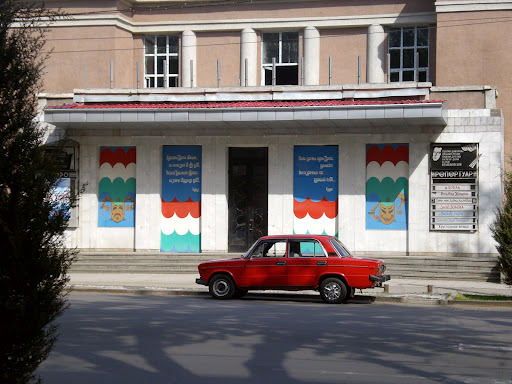
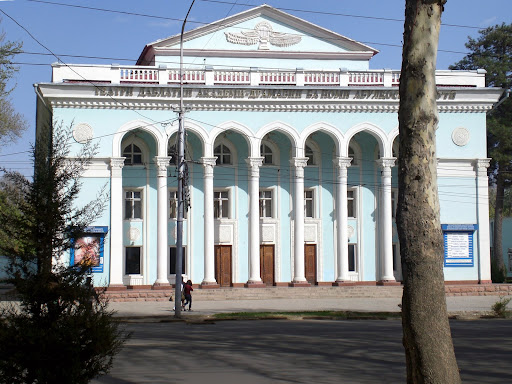
Anya got to see Santa Claus/Ded Moroz a bunch more times, perhaps most excitingly at a children's performance at Dushanbe's Russian theater, the Mayakovsky. (Just down the street is the much grander Tajik theater, the Lohuti, and in my understanding of language and cultural policy in the USSR, it's pretty typical both that the two would exist and that they would have been fairly important institutions in the capital of Tajikistan, placed prominently in the heart of downtown -- despite the Russian theater's decidedly less glamorous visual representation. I'm interested to know more about them, though -- both about their lives in Soviet times as well as the life each of these institutions has led during Tajikistan's independence. The Lohuti also happens to be one of my favorite examples of architecture downtown -- gorgeous robin's egg blue walls and pure white columns, with beautiful Orientalist detailing at the capitals and archways of what is otherwise of course a familiar Soviet neo-classical temple.)

A fellow mother from sadik invited us to see a New Year's play -- I thought it was just going to be the usual public "yolka" presentation in the theater lobby, with Father Frost and his granddaughter Snegurochka, but it turned out that was just the beginning. (That yolka link shows you some interesting photos of Soviet yolkas in decades past -- the contemporary version has to be remarkably similar to what came before.)

We had a great time at the first part. Anya was particularly fascinated by the ugly fake nose worn by the Baba Yaga character, and also liked the "boogie voogie" song we danced to (which really was a fairly literal and direct translation of "the hokey-pokey," complete with right feet in and left feet out and all the rest).

Luckily we had been tipped off that this would be followed by a full-fledged play on the actual stage. Unfortunately, since we were sitting about halfway toward the back of the orchestra, and due in part to the moaning baby in the seat next to us (who, together with his grandmother, to my surprise, actually started attracting glares and comments from adults nearby), we didn't really hear or understand very much of it. And even after the grandmother finally took the hint and stepped outside, we'd already lost too much headway to really get into the story. But it had its moments. For Anya, those included the snowstorm (represented by swirling lights on the scrim, apparently generated by an offstage disco ball), and the red Russian peasant dress the main characters chose to dress their female scarecrow in.

From what I can tell, this was actually a recent play by a living playwright, entitled "Snegurochka Dasha." I could tell we were watching something in which two regular characters were stand-ins for Father Frost, his young sidekick, and the humorous bad guy figure of Baba Yaga, complete with a dream sequence in the middle that gave them to us in their full fairy-tale likenesses (think "The Wizard of Oz" in Russian with more red-nosed old guys and fewer animal characters. And a lot less music, unfortunately for those under 3 and for those hearing- and/or linguistically-challenged!). Luckily I had enough bear crackers and baby cookies to tide us over the hour or so it lasted and all the way home.

Hopefully our next public performance, a possible trip to the Dushanbe Circus next week, will be easier to follow and more small-kid-friendly than "Dasha."